Nov – Dec
Peak season
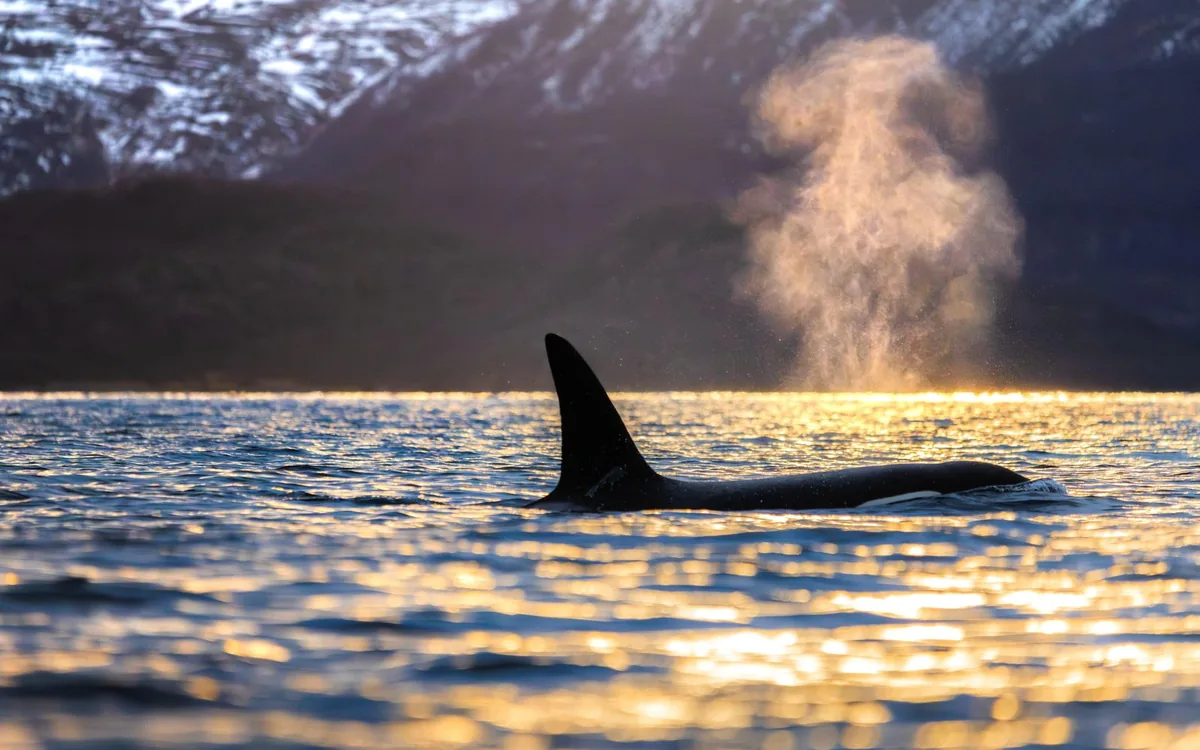
The herring are in, and so are the humpbacks and orca. Sighting rates are at their highest and the daylight is at its lowest — in December there is none at all, only several hours of blue twilight. Book one to two weeks ahead.
Season
This is the question that decides everything, and the answer is not a fixed date range. The whales are here because the herring are here, and where the herring overwinter has shifted twice in living memory. What has stayed constant is the shape of the season: it opens in November, peaks around the turn of the year and thins through January.
Quick answer
Whale watching season in Tromso runs from about November to January. November has the most daylight and fewer people; December is the peak for animals and the darkest month; January still delivers and the light comes back fast. From February the herring disperse and sightings fall away sharply. Safaris start at $204 and do not run at all in summer.
Month by month
Five stars means both that the animals are likely and that the day is workable.
Nov – Dec
The herring are in, and so are the humpbacks and orca. Sighting rates are at their highest and the daylight is at its lowest — in December there is none at all, only several hours of blue twilight. Book one to two weeks ahead.
Jan
Still very good, and the light returns quickly through the month. Numbers thin towards the end as the fish start to disperse, and the boats sometimes travel further.
Feb – Mar
Sightings fall sharply once the fish leave. Some operators keep sailing; in most years a fjord cruise is the better booking in these months.
Apr – Oct
No whale safaris from Tromsø. The same boats run fjord cruises, fishing trips and midnight-sun sailings instead.
Why the dates move
Vestfjorden, then Kvænangen, now Skjervøy — and the day gets longer with the distance.
Norwegian spring-spawning herring do not overwinter in the same place forever. In the 1980s and 1990s the winter concentrations were in Vestfjorden, near Lofoten. Then they moved north into Kvænangen. In recent seasons the largest gatherings have been around Skjervøy, two to three hours north of Tromsø.
Nobody fully controls this. It appears to be driven by water temperature, the strength of each year class of fish and the availability of the plankton they feed on. What it means for a visitor is simple: the whales are wherever the herring are, and that address changes.
The practical consequences are the length of the day and the price. When the fish were close to Tromsø, a whale safari was four hours. Now the best sightings often mean an eight to twelve-hour day, either by fast boat or by road to Skjervøy and out from there.
The good news is that the operators track this daily. If you ask where they are finding the animals this week, they will tell you, and the honest ones will also tell you when they are not finding them.
Booking by month
None of these is about the operator.
Real daylight, animals arriving, fewer people, and slightly lower prices.
The best sighting rates and the polar night. Photographers love it and it is not for everyone.
By the end of the month there is real daylight again, and the fish are starting to thin.
The herring disperse and the odds fall away. Book a fjord cruise instead.
It is peak season in Tromsø for every reason, not just whales.
Weather cancels safaris in this season and a second attempt is the difference between seeing whales and not.
If you are here in December specifically, the polar night changes both the odds and the photographs.
December in detail→What a sighting rate actually means
High rates are real; they count backs and blows, and they move with the fish.
Several operators here publish a sighting rate: the share of trips on which whales were seen. In a good season those numbers are high, and they are worth reading with two things in mind.
First, a sighting is not a spectacle. A blow and a back at two hundred metres counts and should — that is what whale watching mostly is. The breaching humpback in the listing photograph is a good day, not an average one.
Second, the rate is seasonal, not eternal. A rate quoted from a season when the herring were an hour away means something different from the same rate when the fish are three hours north. Ask when the number is from.
What protects you is not the percentage but the policy: several operators offer a discount or a second trip if nothing is seen. That is the honest version of a guarantee, and it exists precisely because blank days do.
If your safari is cancelled
Weather cancels trips here regularly and the recovery is usually easy.
Operators would far rather move you than refund. If you have another day, use it.
A cancelled RIB does not mean the catamarans are staying in. Bigger hulls sail in worse weather.
Wind usually builds through the day in winter, and the early departure is the surest one.
Every safari here can be cancelled by you up to 24 hours ahead, so holding two options is legitimate.
Dog sledding, the cable car, the Polar Museum. All of them run when the sea does not.
Common questions
Late November to December for the highest sighting rates, and January if you want more daylight with still-good odds.
Sometimes, early in the month, but the herring are dispersing and sightings fall away. Most operators wind the safaris down and switch to fjord cruises.
Not in numbers that support safaris. The whales follow the winter herring; in summer the boats run fjord cruises, fishing trips and midnight-sun sailings.
Because the herring have shifted their wintering grounds — from Vestfjorden to Kvænangen and now to the water around Skjervøy. The whales follow the fish.
Five to seven hours in early November, none at all between about 27 November and 15 January, and rising quickly through late January.
One to two weeks in December, which is the busiest month in Tromsø. A few days is usually enough in November and January.
Go deeper
What the season is, what you see and how the day runs.
The verdictSeven safaris ranked, and which suits which traveller.
OrcaFamily groups, herding herring, and where to see them.
SkjervoyWhy the boats sail three hours north, and what it buys.
SilentWhat a hybrid-electric hull changes when you approach a whale.
ComparedCabin, speed or eye level. The three trade-offs.

Tromsø: Whale Watching Tour by Hybrid-Electric Boat
★ 4.5 · 6,651 reviews · Free cancellation 24 h