Orca
Orca in Tromso: family groups, herring balls and a fin you can see from a kilometre away
Orca are the animal most people are hoping for, and northern Norway in winter is one of the few places on earth where you can reliably watch them hunt. They come for the herring, they work in families, and the technique they use to feed here is one of the more remarkable things in the sea.
Quick answer
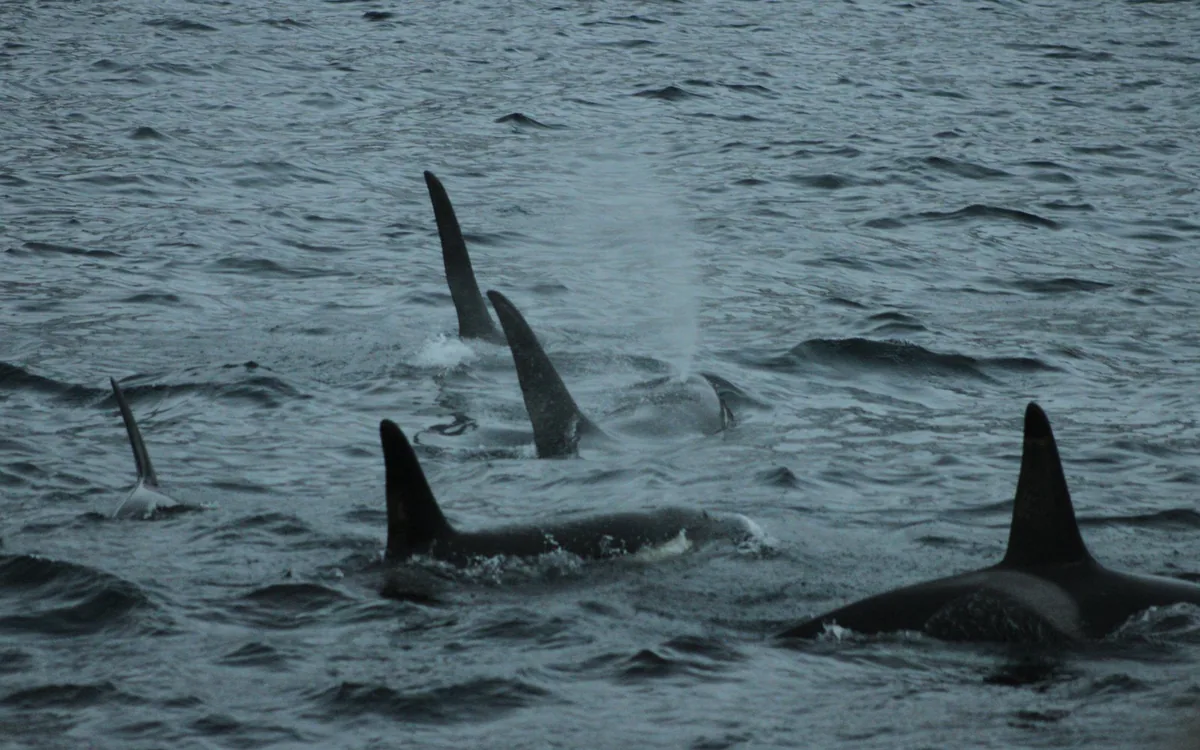
Orca are seen on Tromso whale safaris throughout the season, roughly November to January. They travel in family groups — sometimes dozens of animals — and feed by herding herring into a tight ball and stunning the fish with their tails. Adult male dorsal fins stand up to 1.8 metres out of the water. Safaris that reach them start at $204; the RIB at Skjervøy at $245 gets you closest to the water.
Orca in northern Norway, at a glance
- Season
- Nov – Janwith the herring
- Group size
- Family podsfrom a handful to dozens
- Male dorsal fin
- Up to 1.8 mvisible a long way off
- Length
- 6–8 mfemales smaller than males
- How they feed here
- Carousel feedingherding fish, then stunning them
- Alongside them
- Humpbacksfeeding on the same shoals
- Best boat for photos
- RIBeye level, no glass
- Where lately
- Around Skjervøytwo to three hours north
- Guaranteed?
- Nohigh odds in season, not a promise
- Swimming with them
- Not on these toursa separate, specialised activity
Carousel feeding
What orca actually do to a herring shoal
Herd, compress, strike with the tail — and the humpbacks and birds take their share.
Orca in Norway use a technique that has been studied here for decades and is not seen everywhere in the world. A family group finds a shoal of herring, works around and beneath it, and drives the fish upwards into a tight, compressed ball just under the surface — the carousel.
Then they hit it. An orca turns on its side and strikes into the ball with its tail fluke, and the shockwave stuns the fish. The whales come back and pick off the stunned herring one at a time. Above the water you see churning, birds diving into the same spot, and fins circling the same patch of sea.
Humpbacks exploit exactly the same work. A humpback will lunge straight up through a ball the orca have concentrated, taking a share that the orca cannot prevent. Watching both species feed on the same shoal at the same time is the single most spectacular thing that happens on these trips, and in a good season it happens regularly.
It also explains the birds. Gulls, kittiwakes and sea eagles follow the carousel, and a dense raft of working birds is what the crews are scanning for. If you learn to watch the birds rather than the water, you will often see the feeding start before it is called.
Seeing orca well
Six things that make the difference
The animals do the work; these decide what you get out of it.
- Choose a boat that goes where the fish are
That may mean Skjervøy rather than Tromsø, and a longer day.
- Watch the birds
A dense raft of feeding gulls marks a herring ball, and the orca will be under it.
- Learn the fins
A tall straight fin is an adult male; curved and shorter is a female or a young animal. Family groups usually show both.
- Stay outside
Nothing is seen through a salt-covered window, and orca surface without warning.
- For photographs, take the RIB
Eye level with the animal changes the picture entirely, and there is no railing in the frame.
- Do not expect them to approach
These are wild animals working. Boats keep their distance and the whales come closer when they choose to.
Skjervøy is where the herring have wintered in recent seasons, and it is why the boats now sail three hours north.
Skjervøy safaris→The orca of northern Norway
Resident families, known individuals and a long research record
Matrilineal families, learned hunting culture, and individuals recognised by their fins.
The orca that feed on Norwegian herring are not occasional visitors. They are a studied population with known family groups, and researchers identify individuals by the shape of the dorsal fin and the grey saddle patch behind it — the same technique used with humpback flukes.
They live in matrilineal groups: an older female, her offspring, and their offspring, travelling together for life. The hunting behaviour is cultural as much as instinctive — carousel feeding is learned and passed on, and populations elsewhere in the world hunt completely differently.
Some of the same animals are photographed year after year, which is how the shifting of the wintering grounds was documented: the whales appeared in a new fjord, and researchers recognised the fins.
Guides on the better boats know this material and will tell you which family you are looking at if the encounter is long enough. It is worth asking — it turns a fin in the water into an animal with a history.
Orca myths worth dropping
Five things people arrive believing
None of them survives an afternoon on the water.
- “Killer whales are whales”
They are the largest member of the dolphin family. The name comes from an old term for whale-killers.
- “They are dangerous to people”
There is no record of a wild orca killing a person in the sea. Boats keep their distance for the whales’ sake, not yours.
- “A tall fin means an old animal”
It means a mature male. Females and juveniles have shorter, curved fins whatever their age.
- “They all hunt the same way”
Populations specialise: some eat seals, some eat sharks, these eat herring. The techniques are learned and distinct.
- “You can swim with them here”
Not on these safaris. Snorkelling with orca is separate and licensed.
Common questions
Orca in Tromso, answered
When can you see orca in Tromso?
Through the whale season, roughly November to January, wherever the herring are concentrated. They are seen on most safaris in a good season, and never guaranteed.
How close do you get to orca?
Boats keep a respectful distance and the animals close it when they choose. On a RIB you sit a metre above the water, which changes the experience far more than a few metres of distance would.
What is carousel feeding?
Orca herd a herring shoal into a tight ball near the surface, then stun the fish by striking into it with their tails. Humpbacks and seabirds feed on the same concentrated shoal.
How big are the fins?
An adult male dorsal fin can stand up to 1.8 metres clear of the water, which is why you can spot a pod at a considerable distance.
Can you swim with orca in Tromso?
Snorkelling with orca is a separate, specialised activity with its own operators and rules. None of the safaris on this page includes it.
Which safari is best for orca?
Any of them, in season. For photographs, the RIB at Skjervøy at $245; for comfort and evidence, the hybrid-electric catamaran at $214.
Go deeper
More on Tromso whale watching
Whale watching from Tromso
What the season is, what you see and how the day runs.
The verdictWhich safari is best
Seven safaris ranked, and which suits which traveller.
SeasonSeason and sightings
November to January, and why the dates move with the fish.
SkjervoySkjervoy safaris
Why the boats sail three hours north, and what it buys.
SilentThe silent boat
What a hybrid-electric hull changes when you approach a whale.
ComparedWhich boat
Cabin, speed or eye level. The three trade-offs.
